Latest stories

  • Models & Products

    I gave Opus 5.5 one prompt and six hours to visualize Invisible Cities

    The six-hour one-shot run is notable as an endurance benchmark, but the generated cities still show fidelity errors and the sample is too bounded to establish consistency.

    Discussion summary

    Replies contrast AI-generated work with human-made art and carefully designed exhibits: AI outputs are described as glossy but lacking intent, helpfulness, and reward for close inspection, while human work invites…

    140 points70 comments
  • Research & Evaluation

    OpenAI Withdraws 3 Math Papers

    OpenAI withdrew three math papers after a sign error invalidated a shared construction and revised 14 others; the debate centers on whether external verification is healthy correction or an unpaid burden.

    Discussion summary

    Commenters debate the significance of a few flawed papers among roughly 400, with one calling 3 mistakes a good hit rate and another noting retractions are career-damaging for mathematicians.

    116 points89 comments
  • Research & Evaluation

    OpenAI withdraws three mathematical results

    OpenAI's math repo update withdrew three results and reports only ~42% of top-line results are Lean-formalized; the tweet gives no reasons, while critics question posting unverified proofs.

    Discussion summary

    Commenters question whether results were verified before release. They note only about 42% were formalized in Lean, some results were withdrawn, and formalization can lag.

    40 points30 comments
  • Research & Evaluation

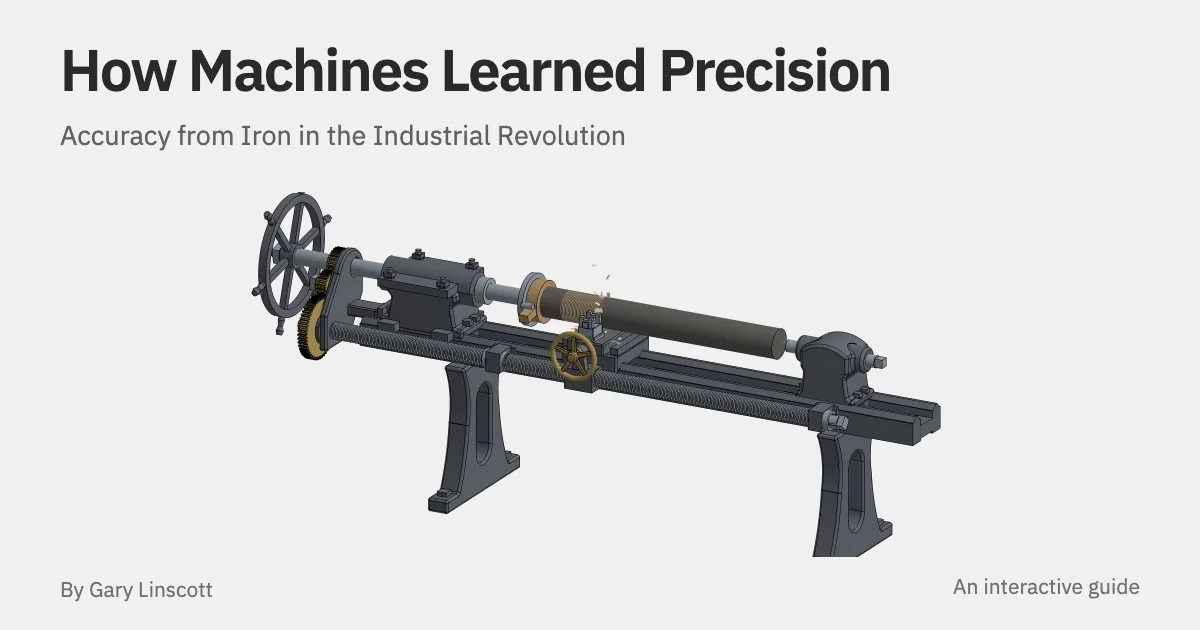
    How machines learned precision

    The article shows how boring mills, scraping, screw-cutting lathes and micrometers bootstrapped industrial precision; the supplied discussion adds little beyond an unanswered question about AI use.

    Discussion summary

    The author introduces a sequel to their beam engine article, focused on Watt's challenges in achieving an accurate cylinder bore for his pistons and on techniques developed during the Industrial Revolution to measure…

    66 points26 comments
  • Industry & Society

    The Mathocalypse

    OpenAI's reported 372-result math dump, including a Unique Games proof, has triggered a verification and readability crisis: Lean certificates may check, but humans have not digested the proofs.

    Discussion summary

    Comments criticize the AI proofs as horribly written, unclear, noisy, and hard for humans to check, comparing them to messy code that still produces correct output.

    105 points82 comments
  • Research & Evaluation

    Nobel Prize in Chemistry 2026 to Henri B. Kagan and Kenso Soai

    The 2026 chemistry Nobel honors Kagan and Soai for non-linear effects and autocatalysis that can produce homochirality; a chemist in the sample argues the press release's novelty framing needs historical context.

    Discussion summary

    A chemist argues the Nobel release overstates the achievement; asymmetric synthesis predated Soai, whose distinctive result was self-amplifying autocatalysis without an external chiral source.

    266 points48 comments
  • Agents & Coding

    Docker Agent

    Docker Agent packages AI agents as a Docker CLI plugin, but the sampled discussion questions the Docker framing and sees another trend-driven agent harness; no comment evaluates the runtime itself.

    Discussion summary

    A Pullboard author argues orchestration is not the core problem; the harder challenge is maintaining agent coherency over long periods and avoiding drift.

    80 points29 comments
  • Models & Products

    GPT‑6 and Intelligent UI for everyone

    OpenAI's GPT-6 brings generated interactive UIs and earlier answering to ChatGPT, but the gains rest on internal evals and the rollout's real-world usefulness remains unverified.

    Discussion summary

    Comments weigh whether generated visuals and interactive explanations suit general recipe users, learners, and decision-makers.

    174 points71 comments
  • Models & Products

    Claude Haiku 5.5

    Anthropic’s Haiku 5.5 claims steep price cuts and large benchmark gains for high-volume tasks, but the 100k-token pricing cliff may limit agentic use.

    Discussion summary

    Commenters analyze Haiku 5.5's tiered pricing, especially the 100k-token cutoff that raises input and output rates.

    83 points32 comments
  • Research & Evaluation

    AI-assisted proof of optimal packing for 11 squares

    The repository reports a Lean-verified optimality proof for packing 11 squares, but the final theorem trusts native numerical certificates, not only Lean's kernel.

    Discussion summary

    Comments note that the readme lacks figures for the packing and point to an external square-packing site, a video, and an image/explanation to make the result less arbitrary or ugly.

    27 points20 comments
  • Models & Products

    Google Playground

    Google Playground promises no-code game creation from text prompts, but the supplied discussion doubts AI can make games fun and reports the try-it link returning 403.

    Discussion summary

    Comments distinguish making a game from making a fun game.

    46 points21 comments
  • Industry & Society

    Forever Junior: The Skills AI Can't Develop for You

    A Criteo junior argues AI agents can leave engineers permanently junior unless they keep questioning, reviewing and occasionally coding by hand; the evidence is one engineer's experience, not a controlled study.

    Discussion summary

    Commenters argue low-level projects and self-written libraries remain valuable for learning, citing raw TCP/HTTP scraping, Linux From Scratch and a custom graph layout library.

    39 points37 comments
  • Research & Evaluation

    Write Like It's 1866: LLMs Relearn Telegraphese

    A benchmark finds telegraph-style 'cablese' cuts LLM output tokens 25–49% while machine readers recover facts at parity or better, though the latent-register claim lacks a strict generic-terseness control.

    Discussion summary

    A commenter complains that LLM output uses physical-object terms such as “sit,” “carry,” “holds,” and “fits” for abstract concepts, and replaces descriptive terms with vague low-signal wording.

    32 points20 comments
  • Models & Products

    Google Playground: Create and play custom games

    Google's Playground promises no-code game creation via prompts, but the small supplied discussion is skeptical, focusing on engagement loops, creative emptiness and child attention.

    Discussion summary

    Commenters debate whether AI can solve 'making a fun game.' One argues games are complex, evergreen, and social, so AI cannot replace human game design and at best generates experiments or assets needing playtesting.

    47 points31 comments
  • Industry & Society

    Reasons to Dislike AI Coding

    Graham argues common objections to AI coding are weak or conditional; the small comment sample splits over labor displacement, cognitive decline and trust, so no consensus emerges.

    Discussion summary

    AI coding can handle boilerplate and support logic, but not deep business logic; abstraction shifts effort to composing generated modules.

    33 points45 comments