Berkeley Fields Medalist Stops Grading Homework After AI Aces It
A Fields medalist has stopped grading homework after AI made top scores routine, but the replacement, proctored exams, may reward luck and health as much as mastery.
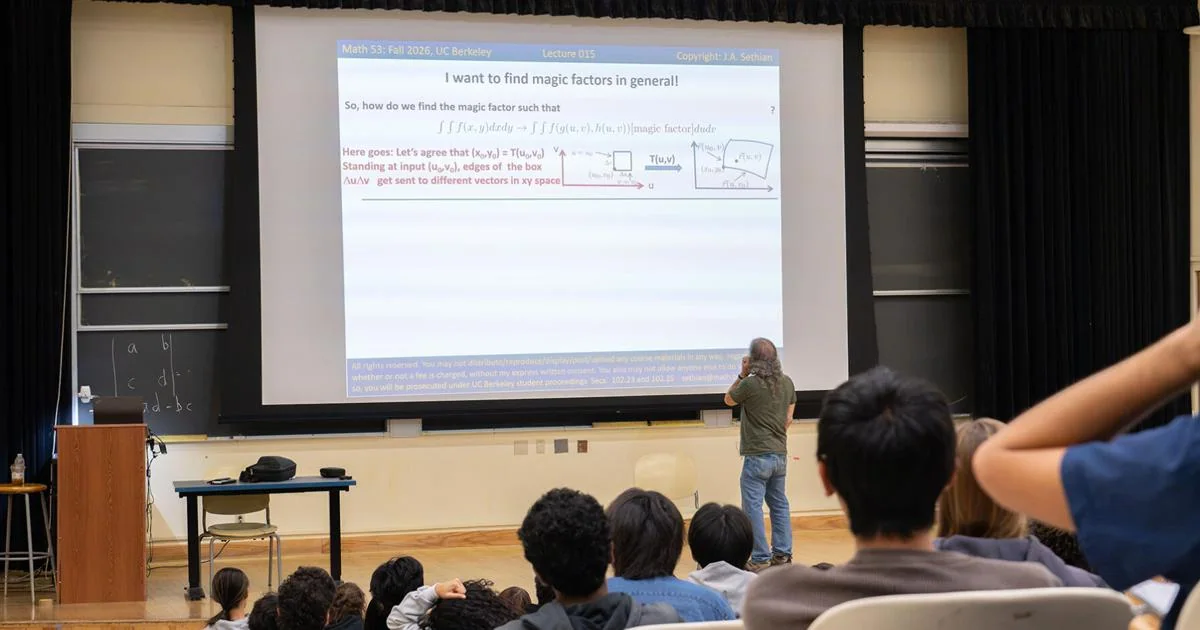
UC Berkeley mathematician and Fields medalist Richard Borcherds has stopped grading homework for correctness after finding that many students used AI to earn top scores, saying there is no point in paying readers to do so. He now grades on completion, a system he calls not a very good system but for which he has no alternative.
In an interview following OpenAI's announcement that AI agents apparently solved the Navier-Stokes existence and smoothness problem, Borcherds warned that if AI keeps improving at its current rate, human mathematicians may soon have nothing they can do better. Berkeley asks faculty to state AI expectations in syllabi, but campus testing found Turnitin and Rumi inadequate for standardization.
Key takeaways
- Borcherds said he no longer knows what to advise students about entering mathematics, noting that five years ago it seemed one of the safest careers from the AI boom; even ChatGPT had no answer.
- He sees inertia in academia and compared mathematics departments to paper journals, which he said have been 'utterly pointless' for two decades, suggesting change may lag AI developments.
- The Berkeley Division of the Academic Senate asks faculty to include AI-use expectations in course syllabi, but direct policies vary by course level and focus area, according to Anne Marie Richard.
- Campus has tried AI detection tools including Turnitin and Rumi but determined they are not adequate to standardize; AI policy remains at faculty discretion, with sample statements available in the AI Hub.
- Borcherds drew historical analogies to hand weaving displaced by looms and horses by motor cars, calling this the first such disruption in mathematics.
What people think
Analysis details
21 comments analyzed. Analyzed .
The sample selects active discussion branches and includes available parent comments. It may omit parts of the full thread. The analysis included 21 of 33 usable stored comments because of the input limit. Selected themes do not measure community opinion or how common a view is.
Proctored exams as the AI-resistant grade
The most concrete proposal is to stop awarding points for take-home work and put full weight on in-class, proctored assessments, with homework kept as practice. That would neutralize AI shortcuts and reduce grading labor, but a single final exam can select for luck, health and executive function rather than mastery. One account says Spanish universities moved from final exams to continuous homework and ended up with worse-prepared students.
Homework's lost forcing function
Graded homework supplied an external incentive to engage with material, and AI removes it. Even copied answers required someone to think through the problems, and incremental points kept less self-motivated students working. The concern is a cohort that needs a stick and may fail exams without it. Counterarguments note cheating always existed and eventually catches up, that students needing such a stick may not be college material, and that answer sharing had social value.
Grading labor and the $20 subscription
Grading is time-intensive: graduate students spend 10-20 hours a week on it, and TAships provide living stipends. A high-profile professor can delegate the work, but less secure faculty must use assistants productively. The deeper economic point is that a cheap AI subscription can make tuition-funded homework points feel worthless, forcing institutions to find a transaction that cannot be undercut so easily.
Equity risk in AI-assisted homework
Premium AI subscriptions may give wealthier students an advantage on take-home assignments, so moving to proctored exams could reduce one inequity. It could also disadvantage students who relied on homework points to offset exam performance. The argument is that institutions must balance AI risk against equity risk at a weighting they can defend.
Higher education's economic shakeout
Predictions that AI and demographics will bankrupt many third-tier institutions drew a request for sourcing, with the counter that the claim has been repeated since the financial crisis. One argument says all higher education now has zero or negative value and that AI-augmented teenagers can outperform PhD teams. A counterpoint says companies will not take over training because they prefer state or student funding, while another says subsidies make education expensive.