Qwen3-4B Fine-Tune Targets AI Writing Tics, but One Reaction Says It Still Reads as AI
A fine-tuned Qwen3-4B aims to strip AI writing tics, but early reactions to its 40-prompt comparison describe output that still reads as AI-written and hard to read.
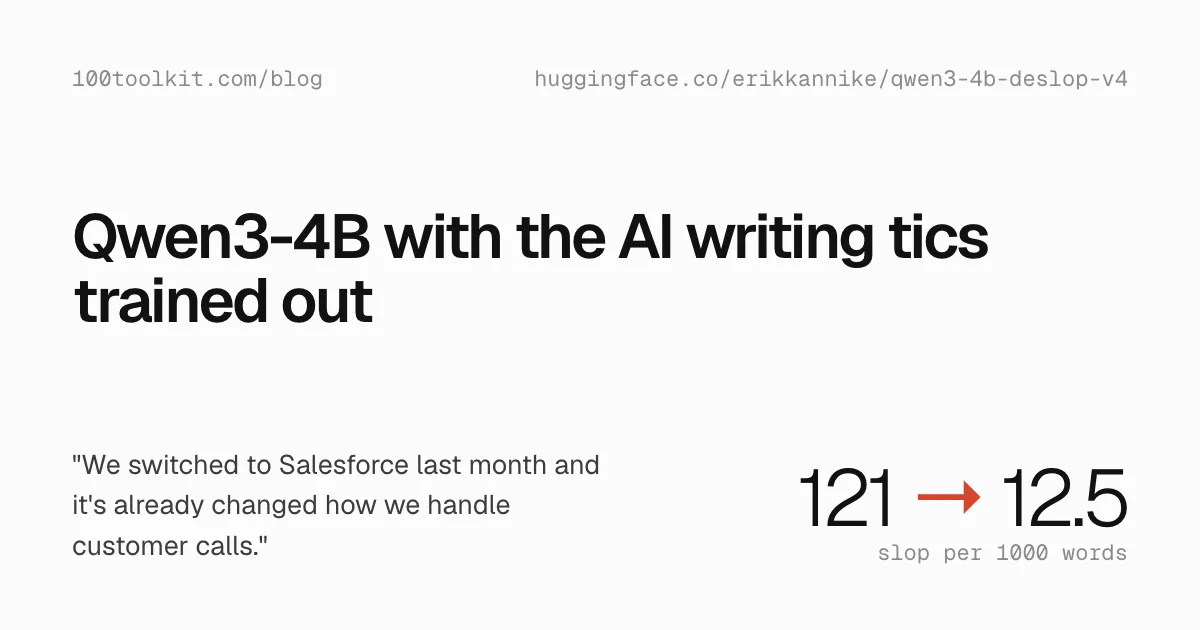
A fine-tuned Qwen3-4B is presented as having AI writing tics trained out, with answers from the original model shown alongside the released one. The evidence offered is a side-by-side run on 40 held-out prompts, scored by a slop detector that counts underlined passages.
The bits that matter
- The comparison spans ten topics in four genres, with no system prompt.
- For each prompt, one answer is sampled from the original model and one from the released model.
- Underlined passages are counted by a slop detector, which is the stated measure of writing tics.
Discussion analysis
Analysis details
9 comments analyzed. Analyzed .
The sample selects active discussion branches and includes available parent comments. It may omit parts of the full thread. The analysis included 9 of 10 usable stored comments because of the input limit. Selected themes do not measure community opinion or how common a view is.
Model sameness makes AI prose recognizable
When many people use the same model, readers tire of its repeated flourishes and learn to identify the style as AI. That homogenization is the backdrop for efforts to remove tics.
Style control remains hard to specify
A predicted style or voice selector, or an agents.md instruction, could dodge sameness, but the hard part is knowing which linguistic terms to request for nuanced, ordinary speech. Caveman or pirate voices are easy; natural register requires vocabulary that specialists may take for granted.
Detectability as a guard for human expression
If LLM text becomes hard to spot, human communication and expression online could be damaged; a hypothetical where 90% of comments are generated and difficult to identify is offered as a reason to keep AI text spottable. The counterargument is that people who prefer their own voices will keep writing, so AI fluency need not displace human expression.
Residual AI style remains hard to read
Assessments of the fine-tuned model's output are mixed but lean critical. It is called a slight improvement that remains obviously AI-written, and the residual style is described as hard to read, forcing re-reading; one suggestion is to ask the model for shorter words. That points to readability as an unresolved limitation beyond tic removal.
Demo page cursors distract
A separate complaint concerns the demo page's distracting cursors, which may affect how the comparison is viewed but says nothing about the model's writing.